
De Profundis Oro Te
An Addendum to "A Corner for Creativity" and "The Consolation of Philosophy 2.0"

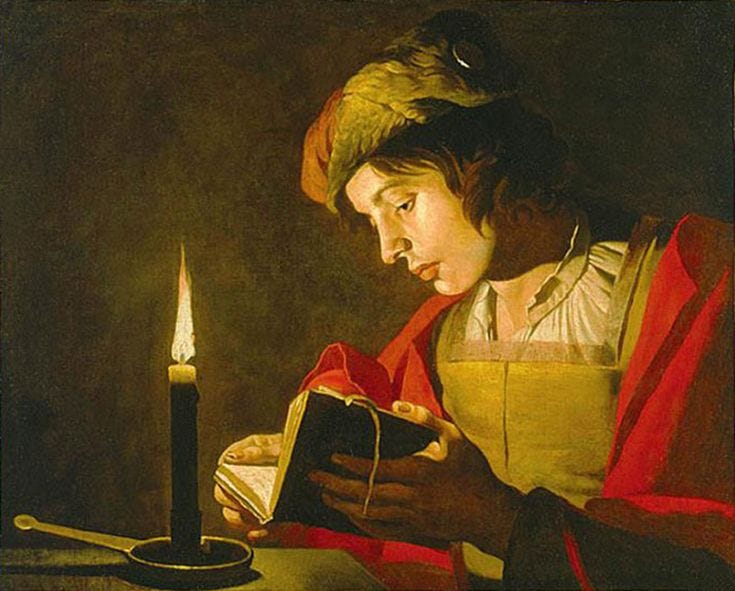
Image Title: “A Young Man Reading by Candlelight” (Matthias Stom)
Image Source: Pinterest
After years of hesitating to open the volume and one unsuccessful attempt at reading it a while back, I finally desired to give my full attention to Sertillanges’s The Intellectual Life. The common claim that the season of life in which we find ourselves influences our views on a given book rang true in my case. Oscillating between two academic career paths- becoming a professor or teaching children-, I felt that the scholar’s insights would resonate with me in a more profound way in this epoch than in prior ones… and was not mistaken.
Like Pieper, Sertillanges is cognizant of the iron fist with which work rules postlapsarian humanity. Just as Pieper bemoans man’s transformation into “a functionary” (37) and “proletarian” who is “fettered to the process of work” (57), so too does Sertillanges lament the apathy of the modern thinker and his tragic detachment from reality. In the first of two upper school literature classes that I recently had the privilege of observing (taught by the same brilliant professor who once opened her lovely home and boxes of tea to me and my classmates and whom I was honored to host a few weekends ago- she will always be a role model for me), a thorough examination of Hopkins’s “God’s Grandeur” took up the first half of the session. I was especially struck by the teacher’s analysis of the lines below:
Generations have trod, have trod, have trod;
And all is seared with trade; bleared, smeared with toil;
And wears man’s smudge and shares man’s smell: the soil
Is bare now, nor can foot feel, being shod.
Industrial and technological advances have cost us our intimacy with the natural world, an intimacy dating from the days when Adam and Eve walked with God in the Garden of Eden, aglow with peace, love, and happiness. Notice what happens when silence rears its head in a conversation. The speakers can only gaze at each other for so long before a keen sense of awkwardness ruptures the eye contact they have worked so hard to achieve and maintain; they check their phones, which have subtly been calling their names throughout the dialogue and awaiting a response from either party, and the “pearl of great price” is lost, or even simply set aside. “This is the way the world end,” T.S. Eliot prophesies, “not with a bang but a whimper” (“The Hollow Men”). Similarly, it is almost impossible for us to make good use of quiet moments in prayer. When we are left to our own devices (sometimes literally), it is probable that we will either open books and compose journal entries or contemplate our surroundings rather than dwelling in divine silence. I believe that Lewis writes extensively about our paradoxical reluctance to encounter God directly. In its awareness of these tendencies- which can be productive but, if unchecked, also distracting-, the Church employs liturgies, symbols, music, and art to keep our eyes and attention on the concrete realities before us (adequatio rei et intellectus) and the things beyond this world. An excellent theology professor at Hillsdale College described the medieval view of the world as a stained glass tinted one: they saw reality in bright colors, absorbing the sights and sounds of nature and the Mass and relishing the gems of their expanding intellectual heritage. Teachers today can and should decorate their classrooms to evoke awe and ardor in their students. That same upper school literature teacher’s classroom is awash with laminated quotes and framed paintings, which adorn all the walls, and a multitude of other embellishments collected over years of engaging and thrilling class after class of curious students. It is, after all, important to institute class and school traditions to remind students of the purpose of their education and the blessing of the bonds forged within the school’s walls; even if specific lines of poetry fade with the years, memories can last a lifetime. Antoine de Saint-Exupery sums it up with great aplomb in “The Generation to Generation,” which I have thought fit to transcribe below:
In a house which becomes a home,
one hands down and another takes up
the heritage of mind and heart,
laughter and tears, musings and deeds.
Love, like a carefully loaded ship,
crosses the gulf between the generations.
Therefore, we do not neglect the ceremonies
of our passage: when we wed, when we die,
and when we are blessed with a child;
When we depart and when we return;
When we plant and when we harvest.
Let us bring up our children. It is not
the place of some official to hand to them
their heritage.
If others impart to our children our knowledge
and ideals, they will lose all of us that is
wordless and full of wonder.
Let us build memories in our children,
lest they drag out joyless lives,
lest they allow treasures to be lost because
they have not been given the keys.
We live, not by things, but by the meanings
of things. It is needful to transmit the passwords
from generation to generation.
As another professor informed me and my classmates in an impactful master’s class, the world of medieval Europe, from its tripartite social structure- the laity, the clergy, and the religious- to its traditions-, was “charged with the grandeur of God” and, like the cathedrals that were its fruits, was oriented towards bringing the world back to its Creator (reditus). Like Adam and Eve, we are supposed to usher the created order to its final, heavenly end. Each being, including man, has its own telos, and we are to promote the attainment of our own goals and those of the lower creatures in our care throughout our earthly lives.
Routes to achieving the human telos can vary drastically. According to Sertillanges and his intellectual hero Aquinas, some can live out fulfilling lives as academics so long as they are prioritizing their duties to God and their fellow men. In the history of philosophy and fiction, “hyper-intellectuals” have racked up a plethora of charges and, collectively, proven an easy target for satirists. From Mr. Casaubon to Alexei Alexandrovich, we have very little sympathy for the slaves of the mind. Hoping to locate the mean (in an Aristotelian sense), Sertillanges contends that “we do not separate the intellectual from the man” and that “thought is born in us after long processes of preparation in which the whole bodily machine is at work” (The Intellectual Life, 57, 34). Spurning dualism and Gnosticism, the philosopher urges his readers, whether dedicated or casual intellectuals, to maintain integrated and holistic selves in the midst of their labors.
To keep our egos in check, Sertillanges constantly employs the motifs of light and darkness, fresh springs of water, seeds, and the ascent up a mountain as he describing the delight and drudgery associated with an academic career. Here are a few examples:
All contemporary psychologists are in agreement here; the fact is plain to see, admitting of no doubt. The “psychology of the feelings” governs practice, but also, to a large extent, thought. Knowledge depends on the direction given to our passions and on our moral habits. To calm our passions is to awaken in ourselves the sense of the universal; to correct ourselves is to bring out the sense of the true. Carry your analysis further. What are the enemies of knowledge? Plainly, lack of intelligence; therefore in discussing vices and virtues and their role in the pursuit of knowledge we presuppose persons who are equal in other respects. But, stupidity apart, what enemies do you fear? What about sloth, the grave of the best gifts? What of sensuality, which makes the body weak and lethargic, befogs the imagination, dulls the intelligence, scatters the memory? Of pride, which sometimes dazzles and sometimes darkens, which so drives us in the direction of our own opinion that the universal sense may escape us? Of envy, which obstinately refuses to acknowledge some light other than our own? Of irritation which repels criticism and comes to grief on the rock of error? Without these obstacles, a man of study will rise to heights greater or less according to his resources and his environment; but he will reach the level of his own gifts, of his own destiny. We must notice that all the faults just mentioned bring one another more or less in their train; they intersect, they ramify, they are with regard to love of the good or contempt for the good what intersecting streamlets are to the spring. Purity of thought requires purity of soul; that is a general and undeniable truth. The neophyte of knowledge should let it sink deeply into his mind. Let us rise higher, and speaking of springs, let us not forget the Supreme Spring. The surest metaphysic tells us that at the summit of things, the true and the good are not only connected, but are identical (22).
Everything that instructs us leads to God on a hidden byway. Every authentic truth is in itself eternal, and its quality of eternity turns us towards the eternity of which it is the revelation. Through nature and the soul, where can we go if not towards their origin? If one does not get there, it is because one has gone off the path. At one bound the inspired and right mind goes beyond intermediaries, and to every question that arises within it, whatever particular answers it may make, a secret voice says: God! Therefore, we have only to leave the mind on the one hand to its upward flight, on the other to its attention, and there will be set up, between the object of a particular study and the object of religious contemplation, an alternating movement which will profit both. With a rapid and often unconscious impulse, we pass from the trace or the image to God, and then, coming back with new vigor and strength, we retrace the footsteps of the divine Walker. We now find things have a deeper meaning, are magnified; we see in them an episode of an immense spiritual happening. Even while we busy ourselves with some trifling thing, we feel ourselves dependent on truths in comparison with which the mountains are ephemeral; infinite Being and infinite duration enfold us, and our study is in very truth, “a study of eternity” (32-33).
St. Thomas at the end of his life, overcome by this sense of the mystery of the All, answered Brother Reginald who was urging him to write: “Reginald, I can no more: all that I have written seems to me but straw.” Let us not have the presumption to wish that this lofty despair should come to us to soon: it is a reward; it is the silence succeeding the great cry with which the whole soul will vibrate in the flood of light revealed; but a little of that awe is the best corrective for the pride that blinds and the pretensions that mislead us. Besides, it stimulates us to work, for distant lights attract us as long as we have the hope of reaching them. On the contrary, if we think that everything has been said and that we have only to learn, we work in a little circle and stick fast in the same spot. A noble character knows that our lights are only the degrees of shadow by which we climb towards the inaccessibly light. We stammer, and the enigma of the world remains unsolved. Study means specifying a few conditions, classifying a few facts; great and fruitful study comes only from putting the little we achieve under the favoring direction of what we do not yet know. That does not mean consigning it to darkness; for it is the light we do not see that best sustains the dim reflections of our astral night. Mystery is in all things the light of what we know; just as unity is the source of number, and immobility the secret of the dizziest speed. To perceive in oneself the murmur of all being and all duration, to appeal to their witness, is, in spite of their silence, to assure oneself the best guarantees for the acquisition of truth. Everything is linked with everything, and the clearly visible relations of things have their roots in the night into which I am groping my way (142-143).
Wordsworth’s ideal poet believes, as Sertillanges expresses it, that “the whole of man is in every man” (75) and that “in the crowd one loses one’s identity, unless one keeps firm hold of oneself, and this hold must first be created. In the crowd, one has no self-knowledge, being burdened by an alien self, that of the multitude” (51). From his earliest days, this archetypal character treasures each moment that he can silently commune with nature, observing,
Wisdom and Spirit of the universe!
Thou Soul that art the eternity of thought!
That giv'st to forms and images a breath
And everlasting motion! not in vain,
By day or star-light thus from my first dawn
Of Childhood didst Thou intertwine for me
The passions that build up our human Soul,
Not with the mean and vulgar works of Man,
But with high objects, with enduring things,
With life and nature, purifying thus
The elements of feeling and of thought,
And sanctifying, by such discipline,
Both pain and fear, until we recognize
A grandeur in the beatings of the heart.
Nor was this fellowship vouchsaf'd to me
With stinted kindness. In November days,
When vapours, rolling down the valleys, made
A lonely scene more lonesome; among woods
At noon, and 'mid the calm of summer nights,
When, by the margin of the trembling Lake,
Beneath the gloomy hills I homeward went
In solitude, such intercourse was mine;
'Twas mine among the fields both day and night,
And by the waters all the summer long (The Prelude, Book One).
While periods of reflection benefit all human souls, companions brighten even the darkest of hours. You need only consider Sam’s restorative influence on Frodo in the second and third books of The Lord of the Rings trilogy and his steadfast loyalty to his friend throughout the series. In one of his most moving quotes (which I’m sure I’ve shared with you before), Sertillanges writes that “friendship is an obstetric art; it draws out our richest and deepest resources; it unfolds the wings of our dreams and hidden indeterminate thoughts; it serves as a check on our judgments [hence the need for accountability partners], tries out our new ideas, keeps up our ardor, and inflames our enthusiasm” (56). He also remarks, “In the inexhaustible wealth of the real, too, we can find much to learn; we must move in it in a spirit of contemplation, not keep away from it. And in the real is not man the most important thing for us- man, the center of all things, the goal to which all things lead, the mirror of all things, inviting the thinker of every specialty to permanent comparisons?” (59). Convicted by these truths, Wordsworth consorted with people of all ranks, traveling throughout his homeland and neighboring countries in search of the truth, which “is commoner than articles of furniture” and “cries out in the streets and does not turn its back on us when we turn our backs on it” (Sertillanges, 73). It’s that same truth whose apparent demise haunted Nietzche as he composed his “Parable of the Madman in the Marketplace.”
“What has been is what will be, and what has been done is what will be done; and there is nothing new under the sun. Is there a thing of which it is said, ‘See, this is new’? It has been already, in the ages before us,” Solomon wrote ages ago (Ecclesiastes 1:9-10). And yet we press onward, convinced we can offer original insights yet ever indebted to previous ages for every breath we take and every thought we think. Most importantly, we owe our very existence and all the familiarity we have with the goodness, truth, and beauty we seek to represent and/ or find in our poems, songs, and books to God. Isn’t this an overt invitation to trust God? We ruminate on the mysteries of Christ’s and Mary’s lives and the nature of the Trinity each time we pray the rosary or attend Mass and stave off doubts and dread as we read Job and the Psalms (especially 130) with trepidation and consider the effects of the Fall, striving to remember that God has a plan and will bring goodness out of evil. We also grieve with those in our midst and the saints as we take in a Good Friday or, as far as I know, Tenebrae service (remember Cordelia’s description of the closing of the chapel at Brideshead Castle?).
While the world is getting brighter and brighter, with electric lights (and atrocious LED and neon ones, too) outlining the skyline and candles going out of fashion, modern souls long for not just the answers to life’s most pressing questions- reasonably so- but also to the most basic ones, including “Why are we here?” and “Is there a God?” We often try to sidestep conversations about worldviews and values in our belief that they will only end in confusion, angst, and hatred; however, these are the “north star” conversations we must be having as pilgrims implicated in a journey spanning generations. We must recall who illumined a dark world in the beginning. Then, we can confidently place one foot in front of the other as we, with God’s help, climb the mountain that is life.
“The world is indeed full of peril, and in it there are many dark places; but still there is much that is fair, and though in all lands love is now mingled with grief, it grows perhaps the greater.” -Tolkien
*I hope to read all of “The Dream of Scipio” and revisit The Consolation of Philosophy soon, as I know both deal with light and darkness and the travails of earthly existence (but also hope with regard to the next life). “The Dream of Gerontius” also examines these themes, inspiring Elgar to compose a magnificent symphony charting its course in a musical way.